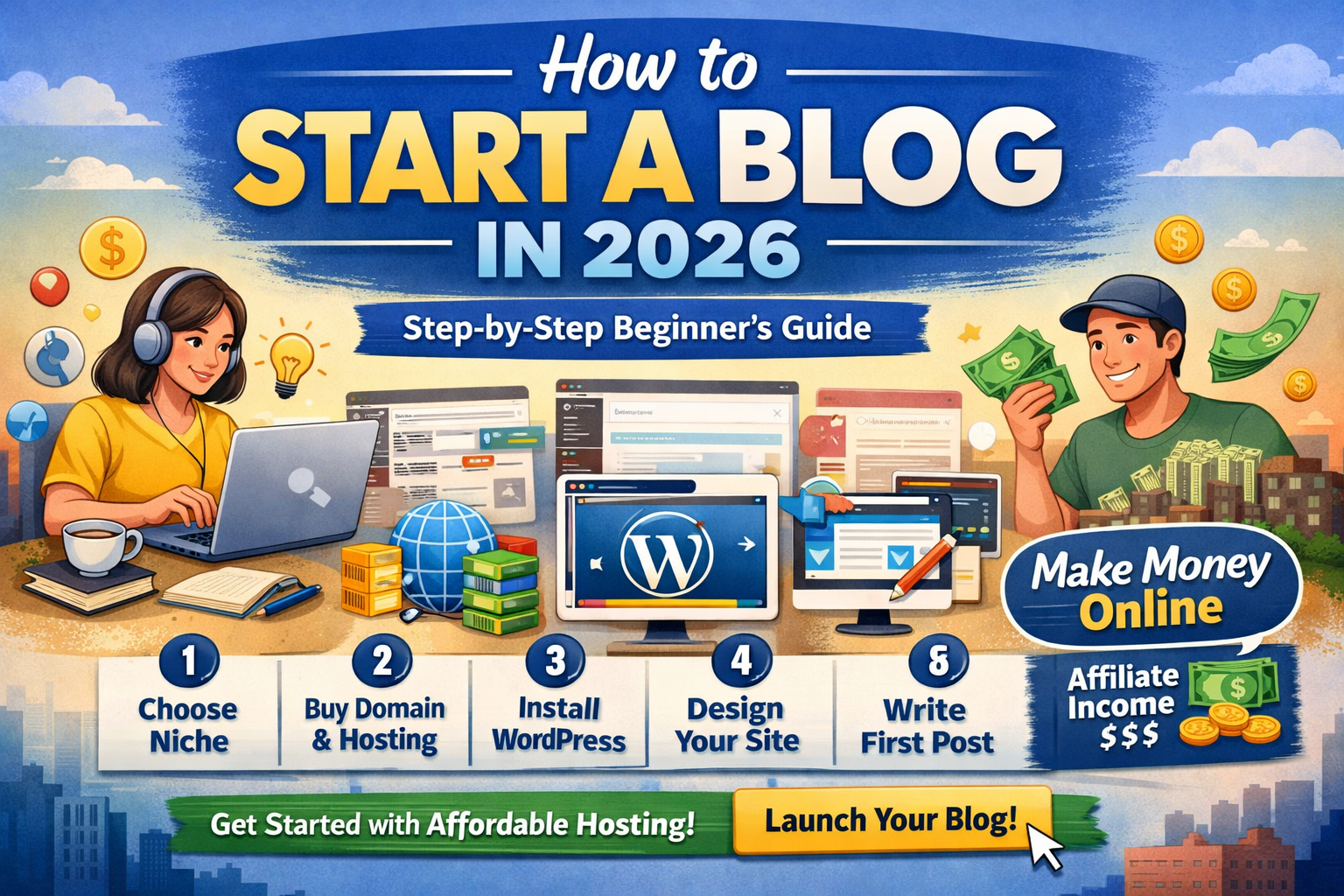
How to Start a Blog in 2026
Step-by-Step Guide for Complete Beginners
Launch your first blog today — even with zero technical skills, zero coding knowledge, and a budget of less than $5/month.
📅 Updated: June 2026
⏰ 12 min read
💬 3,800+ words
You have searched “how to start a blog” and landed here — which means you are already one step closer to building something real online. Maybe you want to earn passive income, share your expertise, grow a personal brand, or simply write about something you love. All of these are valid, achievable goals. The good news? Starting a blog in 2026 is easier, cheaper, and faster than it has ever been before.
The bad news — and nobody talks about this enough — is that most beginner guides skip the important stuff. They mention WordPress and hosting and disappear. They do not tell you why certain decisions matter, what tools actually help you grow faster, or how real bloggers go from zero to thousands of monthly visitors. That is exactly what this guide covers.
We have broken everything into clear, simple steps. Each section is built so that an absolute beginner can follow along without confusion. By the time you reach the end of this page, you will know exactly what to do, in what order, and with which tools — starting today.
⚡ Quick Picks — Top Blogging Tools for Beginners in 2026
| 🥇 Best Overall Book | ProBlogger: Secrets for Blogging Your Way to a Six-Figure Income — The definitive guide for serious bloggers. |
| 🥈 Best Webcam | Logitech C920 HD Pro Webcam — Perfect for recording video content alongside your blog. |
| 🥉 Best Budget Pick | HUANUO Laptop Stand — Ergonomic setup that helps you write more comfortably for hours. |
| 🎙️ Best for Podcasters | Blue Yeti USB Microphone — Top-rated mic for bloggers who also create audio content. |
| 💡 Best Lighting | Neewer 10″ Ring Light Kit — Makes profile photos and video thumbnails look professional instantly. |
📚 Table of Contents
- What Is Blogging & Why Start a Blog in 2026?
- Key Benefits of Starting a Blog
- Step-by-Step Beginner Roadmap
- Top 5 Blogging Tools & Resources for Beginners (Full Reviews)
- Full Comparison Table
- Which Tool Fits Your Blogging Style?
- Pro Tips to Grow Your Blog Faster
- FAQ — Frequently Asked Questions
- Final Verdict
🌎 What Is Blogging & Why Start a Blog in 2026?
A blog is a website where you publish articles — called posts — on a regular basis. Each post typically covers a specific topic, solves a problem, or shares useful information with readers. Blogs can be personal (like online journals), professional (like industry insights), or commercial (like product review sites that earn affiliate income).
Many people ask: “Is blogging still worth it in 2026?” The short answer is yes — absolutely. While the blogging landscape has matured, the core opportunity has not disappeared. In fact, content-driven websites continue to earn millions in affiliate commissions, ad revenue, and digital product sales every single month. What has changed is the strategy: low-quality, rushed content no longer ranks. Thoughtful, well-structured, genuinely helpful content ranks better than ever.
💡 Community Insight: On Reddit’s r/blogging community, new bloggers consistently report their first Google traffic hitting around month 4–6. The ones who stick past month 12 almost universally describe their blog as one of the best long-term decisions they made financially. Patience is the real skill.
Unlike social media platforms — which can change algorithms overnight or ban accounts without warning — your blog is property you own. It is a long-term asset that compounds over time. The traffic you build in year one continues working for you in year three without you creating anything new.
🌟 Key Benefits of Starting a Blog in 2026
1. 💰 Passive Income Potential
Once your blog ranks on Google, visitors arrive even while you sleep. Through affiliate marketing, display ads (Google AdSense, Mediavine), and digital product sales, a well-built blog can generate $500–$10,000+ per month. Many six-figure bloggers started with a $50 investment and a few hours per week.
2. 👥 Build a Personal Brand
Your blog is your professional portfolio, your credibility hub, and your voice on the internet — all in one. Employers, clients, and collaborators search for people online before reaching out. A well-maintained blog communicates expertise far more powerfully than a LinkedIn profile ever could.
3. 🔍 Long-Term Google Traffic
Search engine traffic is the most valuable traffic on the internet because visitors are actively searching for answers — they come with intent. A blog post ranking on page one of Google for a keyword like “best budget laptops for students” can drive thousands of visitors monthly, year after year, without paid advertising.
4. 🎓 Learn Valuable Skills
Running a blog teaches you SEO, copywriting, digital marketing, basic web design, email list building, and analytics — skills that are in high demand across industries. Many bloggers have transitioned their blogging skills into full-time freelance careers or digital marketing jobs that pay $60,000–$120,000 annually.
5. 🎯 Complete Creative Freedom
You decide the topic, the schedule, the tone, and the direction. There is no editor telling you what to write, no algorithm punishing you for posting at the wrong time, and no boss approving your content. Your blog is your space to say something meaningful — and build a business around it.
📌 Step-by-Step Beginner Roadmap: How to Start a Blog
Step 1 — Choose a Profitable Niche
A niche is the core topic your blog covers consistently. Your niche determines your audience, your monetization options, and your growth ceiling. The biggest mistake new bloggers make is choosing a niche that is either too broad (“lifestyle”) or too narrow (“vegan food for left-handed chefs in Vermont”).
The sweet spot is a topic that sits at the intersection of three things: something you genuinely know about (or can research deeply), something people actively search for on Google, and something where affiliate products or monetization options exist. Great examples include personal finance for millennials, home improvement DIY, fitness for beginners, pet care, travel on a budget, AI tools for freelancers, and parenting for first-time parents.
⚠️ Common Mistake: Do not choose a niche just because you heard it is profitable. If you have zero interest in the topic, writing 50+ articles about it will feel like a job you hate. Pick something you can sustain for 12–18 months minimum.
Step 2 — Buy a Domain Name & Hosting
Think of your domain name as your address on the internet (e.g., SimpleTechGuide.com) and your hosting as the actual land where your website lives. Without hosting, your blog does not exist online. The best beginner hosting plans cost between $3–$5 per month and include a free domain name, free SSL certificate (the padlock icon in your browser), and one-click WordPress installation.
When choosing a domain name, keep it short, memorable, easy to spell, and free of numbers and hyphens. Use .com whenever possible — it carries the most trust with readers and search engines. Avoid ultra-generic names that could be confused with other sites.
Popular and beginner-friendly hosting providers include Bluehost, SiteGround, and Hostinger. All three offer WordPress-optimized environments, fast load speeds, and responsive support teams.
Step 3 — Install WordPress in 5 Minutes
WordPress powers over 43% of all websites on the internet. It is free, open-source, beginner-friendly, and endlessly customizable. After purchasing hosting, log into your control panel (usually cPanel or a custom dashboard), find the “Install WordPress” button, select your domain, and click Install. The entire process takes under five minutes.
Once installed, you access your blog’s backend at yourdomain.com/wp-admin. This is where you write posts, customize your design, install plugins, and manage everything about your blog.
Step 4 — Pick a Clean WordPress Theme
A theme controls how your blog looks. For beginners, focus on three things: speed, mobile-friendliness, and simplicity. Popular free themes for beginners include Astra, GeneratePress, and Kadence. All load fast, look professional, and can be customized without touching a single line of code.
To install a theme: go to Dashboard → Appearance → Themes → Add New → search for your theme → Install → Activate. Before writing your first post, create four essential pages: Home, About, Contact, and Privacy Policy. These signal trustworthiness to both readers and Google.
Step 5 — Install Must-Have Plugins
Plugins are apps that add functionality to WordPress. For beginners, install only what you need. The essential four are: an SEO plugin (Rank Math or Yoast SEO), a security plugin (Wordfence), a caching plugin (WP Super Cache or LiteSpeed Cache), and a backup plugin (UpdraftPlus). Keep your total plugin count under 15 — too many plugins slow your site significantly.
Step 6 — Write and Publish Your First Post
Your first post does not need to be perfect. It needs to be published. Start with a beginner guide in your niche — something like “10 Things I Wish I Knew Before Starting [Your Niche]” or a “How To” tutorial. Use a clear headline, break the content into subheadings, keep paragraphs short, and add at least one image. Then hit Publish.
Step 7 — Learn Basic SEO and Publish Consistently
SEO (Search Engine Optimization) is how Google finds and ranks your content. The basics are simple: include your target keyword in the page title, the first paragraph, and a few headings. Write at least 1,200 words per post, link to other pages on your blog (internal links), and get a few links from other websites (backlinks). Resources like Ahrefs Blog and Moz’s Beginner’s Guide to SEO are free and outstanding.
🏆 Top 5 Blogging Tools & Resources for Beginners (2026 Reviews)
📊 Full Comparison Table — Top Blogging Tools 2026
| Product | Best For | Rating | Beginner Friendly | Plug & Play | Budget Friendly | Price |
|---|---|---|---|---|---|---|
| ProBlogger Book | Learning strategy | 4.6 / 5 | ✔ | ✔ | ✔ | $12–$18 |
| Logitech C920 | Video content | 4.7 / 5 | ✔ | ✔ | ✘ | $60–$85 |
| HUANUO Stand | Ergonomic setup | 4.5 / 5 | ✔ | ✔ | ✔ | $22–$30 |
| Blue Yeti Mic | Podcast / Audio | 4.6 / 5 | ✔ | ✔ | ✘ | $99–$129 |
| Neewer Ring Light | Photos / Video | 4.5 / 5 | ✔ | ✔ | ✔ | $25–$40 |
* Prices are approximate and may vary on Amazon. Check the product listing for the current price.
🌟 Which Tool Fits Your Blogging Style?
✍️ You are a pure writer
Start with the ProBlogger book and the HUANUO laptop stand. Master content strategy first, invest in ergonomics so you write longer and more consistently.
🎥 You want to add video
Pair the Logitech C920 webcam with the Neewer Ring Light. Together they cost under $120 and will make your video look like it was recorded in a professional setup.
🎙️ You are building a podcast
The Blue Yeti is your first investment. Audio quality matters more than video in podcasting — a good mic immediately elevates your perceived professionalism.
💲 You are on a tight budget
Start with the ProBlogger book ($14) and the HUANUO stand ($25). Under $40 total and you will have a better strategic foundation than most bloggers with expensive setups.
💡 Pro Tips to Grow Your Blog Faster in 2026
✅ Write for Beginners in Your Niche
Beginner-focused content consistently outperforms expert content in search volume and click-through rates. There are always more beginners searching for answers than experts. Articles titled “How to start X for beginners” and “X explained simply” almost always rank faster and drive more traffic than advanced tutorials.
✅ Build an Email List from Day One
Google rankings change. Algorithms update. Your email list, however, belongs entirely to you. Tools like Mailchimp and ConvertKit offer free plans for beginners. Add a simple opt-in form to your blog from the very beginning and offer a free resource (checklist, PDF, email course) in exchange for subscriptions.
✅ Use Internal Linking Aggressively
Every blog post you write should link to at least two or three other posts on your site. Internal links keep readers engaged longer, reduce bounce rates, and help Google understand the structure of your content. They also pass “link equity” between your pages — strengthening the SEO of your entire site with every new post you publish.
⚠️ Avoid This Common Mistake: Redesigning Instead of Writing
New bloggers frequently spend weeks tweaking fonts, colors, and layouts instead of publishing content. Your design does not need to be perfect — it needs to be clean, fast, and readable. Google ranks content, not design. Write 20 posts before you redesign anything.
❓ FAQ — Frequently Asked Questions About Starting a Blog
How much does it cost to start a blog in 2026?
The minimum cost is roughly $35–$60 for the first year. This typically covers a domain name ($10–$15/year) and basic shared hosting ($3–$5/month). WordPress itself is free. The optional tools reviewed in this guide — books, equipment, and accessories — are investments you make as your blog grows, not requirements to get started.
How long does it take to make money blogging?
Most bloggers who publish consistently (at least two to four posts per month) start seeing their first affiliate income between month four and month eight. Meaningful income — say, $500–$1,000 per month — typically arrives between month 12 and month 24. Bloggers who hit six-figure incomes almost universally report that it took two to four years of consistent, strategic publishing.
Do I need to know how to code to start a blog?
Absolutely not. Modern WordPress with drag-and-drop page builders like Elementor or the built-in Gutenberg editor lets you design beautiful pages and publish polished posts without writing a single line of code. The technical setup (domain, hosting, WordPress installation) is handled through click-based dashboards that any beginner can navigate in under 30 minutes.
What is the best niche for a beginner blogger in 2026?
The best niche for you is one where you can sustain genuine interest for 12–18 months, where there are affiliate products or monetization options, and where people actively search for information on Google. Evergreen niches like personal finance, health and fitness, home improvement, pet care, and digital tools consistently perform well. Emerging niches in 2026 include AI tools, sustainable living, remote work productivity, and side hustle strategies.
Is blogging still relevant with AI content everywhere in 2026?
Yes — and arguably more so than before. Google’s 2024 and 2025 algorithm updates rewarded content with genuine firsthand experience, original perspectives, and authentic author authority. Blogs that demonstrate real expertise and personal experience are now among the highest-ranking content types. AI-generated content flooded the internet, which made genuine human insight more valuable and distinguishable, not less.
How many posts should I publish per month as a beginner?
Quality beats quantity every time. Two to four well-researched, 1,500–2,500 word posts per month is far more effective than publishing ten thin, poorly written articles. Focus on creating the most comprehensive, genuinely helpful post available on each topic you cover. Over time, depth and consistency compound into authority that Google rewards with consistent rankings.
What is the difference between WordPress.com and WordPress.org?
WordPress.com is a hosted platform where WordPress controls your site. Free plans display ads, limit customization, and restrict monetization. WordPress.org is the self-hosted, open-source version that you install on your own hosting server. It gives you complete ownership, unlimited plugins and themes, and full monetization freedom. For any serious blogging goal — especially income — always choose WordPress.org paired with your own hosting plan.
🏆
Final Verdict — How to Start a Blog in 2026
Our honest recommendation after reviewing the full landscape
Starting a blog in 2026 remains one of the most rewarding digital investments you can make — but only if you approach it with the right mindset and tools. The technical barrier has never been lower. The strategic bar, however, has never been higher. What separates blogs that grow from blogs that stall is consistent, high-quality content, proper SEO foundations, and genuine value delivered to a specific audience.
For pure strategy and business foundations, ProBlogger is the most important starting investment at any budget level. For bloggers adding video, the Logitech C920 + Neewer Ring Light combination delivers professional results at an entry-level price. Writers who prioritize long sessions need the HUANUO Laptop Stand to protect their posture and productivity. And for anyone expanding into audio content, the Blue Yeti remains the category standard.
The bloggers who succeed are not the most talented writers. They are the most consistent publishers. Pick your niche, set up your hosting, install WordPress, and write your first post today. Your future readers are already searching for what you know.
